The Epistemic Trap
01Why does physics have no equation for the observer?
Every physical theory presupposes a measurement context, yet none formally accounts for the system that performs the measurement. Quantum mechanics describes what we observe. It says nothing about what it means to observe. This is not a philosophical curiosity — it is a structural gap in the formalism itself.
02Why does neuroscience map correlation but not causation of experience?
We can identify neural correlates of consciousness with increasing precision. We can predict which patterns of brain activity accompany which subjective states. But correlation is not mechanism. No current model explains how electrochemical signalling produces the felt quality of experience — what it is like to see red, to feel pain, to recognise yourself in a mirror.
03What if the explanatory gap is not a limit of knowledge but a consequence of method?
Perhaps the problem is not that consciousness is too complex to understand. Perhaps the problem is that the methodological partition between observer and observed — the very move that made modern science possible — systematically excludes the phenomenon we are trying to explain. A different partition yields a different science.
PsychoRegenesis
PsychoRegenesis
The Origin-Self Recognition
Peter Luxo Ruel
The Origin-Self Recognition
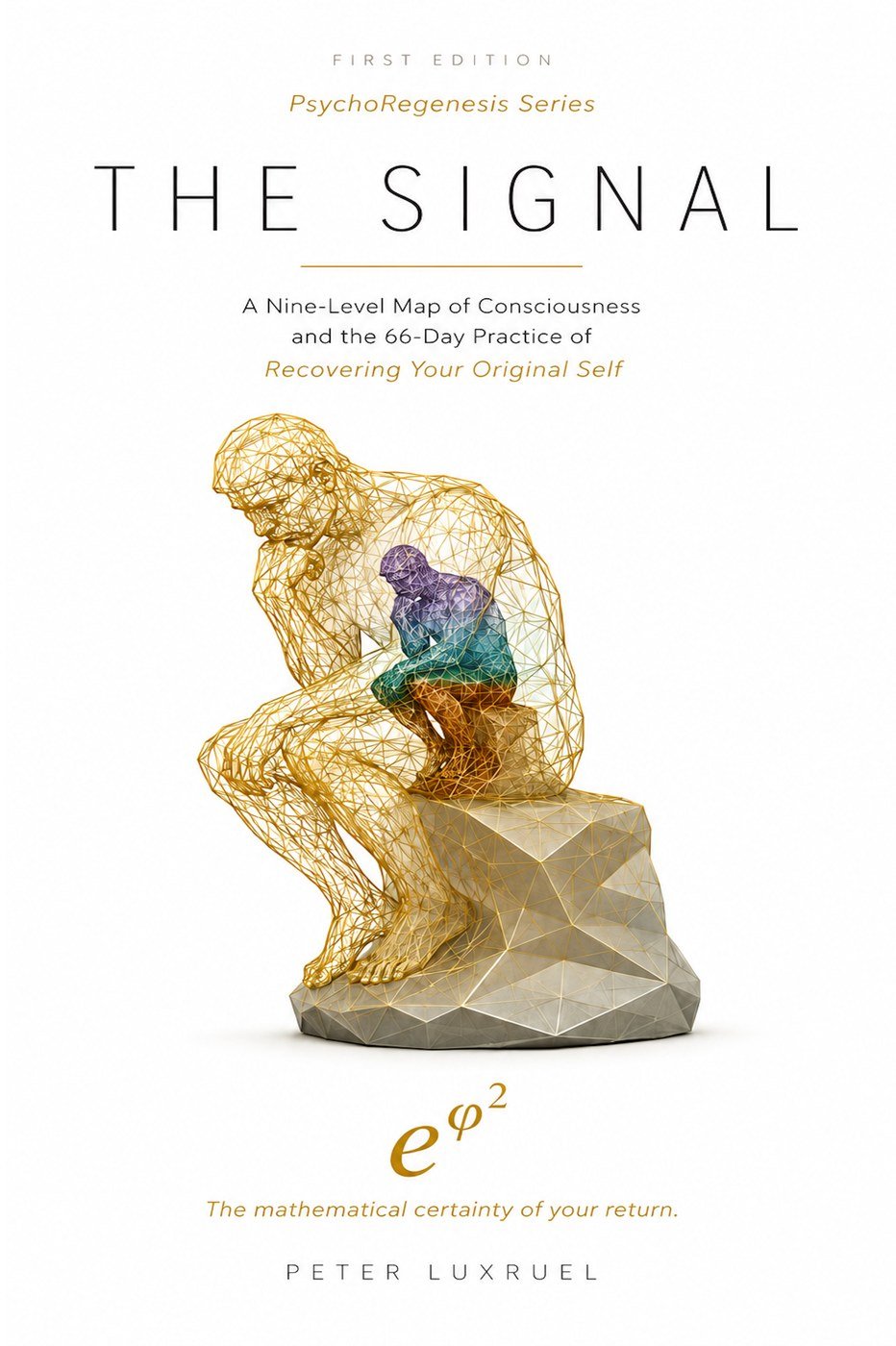
PsychoRegenesis presents the first unified scientific framework for consciousness that bridges the explanatory gap between third-person neuroscience and first-person phenomenology. Grounded in formal information theory, quantum biophysics, and non-equilibrium thermodynamics, it introduces Onto-Syntropics — a nine-field architecture mapping the complete structure of self-aware cognition.
The framework generates testable predictions, proposes novel experimental protocols, and includes a 66-day practice methodology grounded in the same mathematical structure as the theoretical architecture — making it the first consciousness framework to unify theory and praxis under a single formal system.
“Consciousness is not what the brain produces. It is what the brain constrains. The difference is everything.”
Published Work & Ongoing Research
The Bio-Regenerative Scaling Law
Formal derivation of the scaling relationship between bioelectric coherence and regenerative capacity, with supporting data from multiple organism models.
Onto-Syntropics: A Nine-Field Architecture for Consciousness
Conference presentation introducing the three-domain framework and its relationship to existing theories in consciousness science.
PsychoRegenesis Executive Summary
12-page synthesis of the complete framework, suitable for researchers, conference organizers, and publishers evaluating the work.
Ongoing research extends the framework into applied state governance and biosignal coherence architecture. The following papers are in preparation:
Applied State Governance Architecture
Extension of the framework into measurable biosignal coherence protocols.
In preparationSyntropy-Coherence Signal Processing Model
Formal information-theoretic treatment of the S³ architecture.
In preparationWhere the Framework Applies
Four domains where the nine-field architecture generates concrete, testable applications beyond theoretical consciousness science.
Health Technology & Biomedical Research
The triadic incoherence model provides a new diagnostic framework mapping measurable biomarkers to specific coherence breakdowns across the three domains. This enables precision identification of where in the phenomenal-causal-principal hierarchy a given pathology originates, rather than treating symptoms at a single level.
Neuroscience & Consciousness Studies
The TRN mapping and four-network hierarchy generate testable predictions about thalamic reticular nucleus dynamics, default mode network transitions, and cross-frequency coupling patterns that differentiate between states of consciousness. These are specific enough to design fMRI and EEG protocols around.
Organisational & Systems Performance
Coherence architecture applied to collective systems yields a formal model of organisational intelligence. The nine-field map scales from individual cognition to team dynamics and institutional structure, providing diagnostic and design tools for systems that need to think together.
Education & Human Development
The nine-field map as a developmental framework reframes education from knowledge accumulation to coherence cultivation. Each field corresponds to a specific developmental capacity, making it possible to identify precisely where a learner's development is constrained and what intervention would address the actual bottleneck.
Peter Luxo Ruel
The path to PsychoRegenesis runs through an unusual intersection of disciplines: Computer Engineering, an MBA in data-driven strategy, twelve years of formal consciousness research, and graduate work at MIT's Institute for Data, Systems, and Society. The framework reflects this transdisciplinary trajectory — it applies the rigour of information theory and signal processing to the hardest problem in science.
This is not a philosopher speculating about consciousness. This is an engineer who spent a decade learning to formalise what others had only described. The result is a framework that speaks the language of both the laboratory and the lecture hall — measurable, falsifiable, and grounded in mathematics that working scientists can engage with on their own terms.
Get in Touch
For speaking engagements, research collaboration, or manuscript enquiries.
© 2026 PsychoRegenesis. All rights reserved.